The Sports Authority

By Maurice Pinzon
Yesterday the Mayor’s Office announced that U.S. Senator Hillary Rodham Clinton had agreed to participate in New York’s Olympic bid presentation to the International Olympic Committee (IOC) in Singapore. In Singapore Senator Clinton will join about 40 Olympians including Muhammad Ali. Earlier in the week, Mayor Bloomberg invited Secretary of State Condoleezza Rice to attend a send-off rally in City Hall Park for the delegation headed to Singapore.

But with just four days left before the IOC selects the host city for the 2012 Olympics, Queens residents will have little opportunity to respond to the Olympic committee’s plan to build a new stadium and media center in their borough. Manhattan residents, however, had months, if not years, to weigh in on the emerging details about the Olympic stadium.

Public opinion polls conducted about the Olympic stadium in Manhattan usually showed a decrease in public support once people learned how much money the City would have to invest in the stadium.

A large portion of Queens elected officials supported the Jets – Olympic Stadium on the West Side of Manhattan, thus leaving Queens residents vulnerable to having to accept the last minute plans thrust upon the borough by the Bloomberg administration and NYC 2012.

The Queens elected officials in effect allowed Queens to be taken for granted as the “Plan B” site with little time for review. The Queens delegation included, Congressman Joseph Crowley and Queens Borough President Helen M. Marshall, 10 out of the 14 members representing Queens in the city council, Joseph P. Addabbo Jr., Tony Avella, Leroy G. Comrie Jr., Dennis P. Gallagher, James F. Gennaro, Allan W. Jennings, John C. Liu, Hiram Monserrate, Helen Sears and David I. Weprin.

Thirteen out of 18 Queens assembly members: Brian McLaughlin, Ann Margaret Carrozza, Barbara M. Clark, Michael N. Gianaris, Nettie Mayerson, Jimmy Ming, Catherine T. Nolan, Jose R. Peralta, Audrey I. Pheffer, William Scarborough, Anthony S. Seminerio, Michele R. Titus and Marc Weprin. And 4 of 7 Queens state senators, Serphin R. Maltese, Ada L. Smith, Malcolm A. Smith and Toby Ann Stavisky.

It is not clear if these legislators thought the economic development arguments the Bloomberg administration was making, that a Jets – Olympic stadium would benefit the West Side, would not apply to Queens, or if the legislators agreed with Mayor Bloomberg that submitting the City’s Olympic bid with a stadium located in Queens was not the best way to get the bid.

Under the current proposal for a new Mets Stadium, the City would invest $85 million in infrastructure and site preparation costs. An additional $75 million would come from New York State. If New York is selected in Singapore on July 6 to host the Olympic Games, the stadium would temporarily be converted into an 80,000 seat Olympic stadium at an additional cost to the City and State of $108 million.

Although the Mets would build the new stadium and pay for it with their private money, it would still be located at Flushing Meadows-Corona Park, just east of where Shea Stadium now stands. The Mets would no longer pay rent for the stadium since they would own the facility, but they would also not pay any rent on the land. And it is still not clear the full extent of the tax benefits the Mets would receive or the revenues the Mets would share with the City from the parking fees or other potential revenue streams.

These are accounting matters presumably to be ironed out later.

But the Mets track record is spotty in this regard. In a July 2003 audit conducted by Comptroller William C. Thompson, the comptroller recommended that the Mets pay $4.5 million. The audit indicated the Mets owed $1.2 million to the City in addition to $3.4 million the team had yet to pay from previous assessments for a total amount of $4.5 million. While the audit was being conducted the Mets paid $590,113 and eventually settled with the City’s Law Department for $2.75 million.

Although no legal action was taken against the Mets by the Law Department, at the time of the audit’s release in a statement Comptroller Thompson said, “The amount the Mets owe from this audit is startling, but when you add millions more from previous audits, this pattern becomes particularly troubling.”

At the request of the Parks Department, the comptroller’s office is currently conducting another audit for calendar year 2002.

Furthermore, if New York does win the Olympic bid, the International Broadcast Center and Media Center would be located in Willets Point, a neighborhood in which much of the property is privately owned. An additional large track along the waterfront is owned by the MTA. Communications with Flushing Community Board 7, which covers both downtown Flushing and Willets Points, was just about shut down after the City’s bidding process was initiated for a track of land in downtown Flushing and after EDC issued its Willets Point RFEI. (See our article The Other Sports and Convention Center).

Nevertheless, the New York City Economic Development Corporation moved forward and issued a Request for Expressions of Interest (RFEI). Until now it has refused requests from New York News Network and others to release the list of companies or organizations that have proposed to develop the Willets Point site.

Independently, New York News Network has received confirmation from the Queens Chamber of Commerce and the real estate development company Forest City Ratner – which hopes to build a controversial Nets basketball arena in Brooklyn – that each has submitted a proposal in response to EDC’s Willets Point RFEI.

The change in location from Manhattan’s West Side to Queens required NYC2012 to revise the “candidature file” it submitted to the IOC. But Laz Benitez, a spokesman for NYC2012, told New York News Network that specifics about NYC2012’s revised bid – which includes a new Mets stadium that could be expanded into an Olympic stadium if New York wins the bid – and the International Broadcast Center and Media Center, cannot be released until the IOC approves the revised plan. As of this writing NYC 2012 has not released to the public any details on the revised plan aside from a rough sketch of the proposed Olympic stadium.

According to the IOC’s guidelines, the bid New York City submits is a legally binding document that carries the “Force of Obligation”. The text contains this highlighted portion: “It is very important to remember that all representations, statements and other commitments contained in the Candidature File are binding in the event that the city in question is elected to host the Olympic Games.”

In a telephone interview yesterday with City Council member Hiram Monserrate, who represents the Queens district where the new Olympic stadium and media facilities would be located, Mr. Monserrate said that Deputy Mayor Daniel L. Doctoroff had briefed him and other council members about the new stadium. But the council member conceded the presentation was not very detailed. Council member Monserrate indicated that he still had “concerns about the secrecy of this proposal.”

He added, “I will be working towards ensuring that this process is transparent and that there’s a community benefit agreement for the people of Queens.”

Jordan Barowitz a spokesman for Mayor Bloomberg said, “There is overwhelming support for the new stadium not only in the borough of Queens but across the City.”

Posted in Economy, Government & Politics | Comments Off on The Sports Authority

Queens Now Central to New York’s Olympic Bid

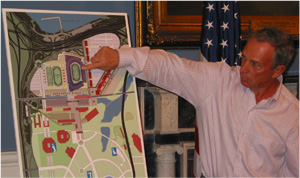
Mayor Bloomberg Shows Mets Stadium Design (Photo by Maurice Pinzon)

Mayor Bloomberg Shows Mets Stadium Design (Photo by Maurice Pinzon)

By Maurice Pinzon
At an unusual Sunday night news conference at City Hall, Mayor Michael R. Bloomberg announced that New York City would submit a revised Olympic stadium plan to the International Olympic Committee (IOC), locating the proposed Olympic stadium in Willets Point, Queens.

The Bloomberg administration negotiated an agreement with the Mets organization so that the team would build and fund a new stadium scheduled to be ready for the Mets 2009 baseball season. New York City and New York State would spend a proposed $160 million on infrastructure and site preparation costs for the new stadium.

If New York is selected in July to host the 2012 Olympic Games, the new stadium would be converted to an Olympic Stadium configuration after the Mets’ 2011 baseball season. This would cost an additional $250 million with NYC2012, New York’s Olympic organizing committee, paying $142 million of the cost and the City and State each funding half of the $108 million balance.

The new stadium would be located at Shea Stadium’s current eastern parking lot, abutting 126th Street, and across the street from the Willets Point auto repair shops and junkyards. That property would have to be condemned by the City so NYC2012 could convert it into Olympic press facilities.

But even if New York does not win the Olympic bid, the Bloomberg administration has looked to develop Willets Point since 2002. (See our The Other Sports and Convention Center

Last night Mayor Michael R. Bloomberg said, “Having the Olympic stadium at the Shea Stadium site is also consistent with our plans for the development of Willets Point, for which we just received an amazing amount of interest from potential developers.”

Last week, Janelle Patterson, a spokeswoman for New York City’s Economic Development Corporation (EDC) told New York News Network that 13 proposals to develop Willets Point had been submitted to EDC and that the agency was actively negotiating with the interested parties. These development proposals may now be structured to complement the new stadium proposal, along with plans by the City to develop downtown Flushing and the waterfront along Flushing creek, which is located between Willets Point and downtown Flushing.

The U.S. Army Corps of Engineers has been dredging Flushing creek with funds provided by Congressman Joseph Crowley, with the goal of cleaning up the creek and restoring parts of its ecosystem.

The City owns Shea Stadium and the land surrounding the stadium. But since the Mets will own the new stadium, they will not pay rent currently paid to the City. In turn, the City will not incur the infrastructure costs it spends to maintain the outmoded Shea Stadium. New York News Network previously reported that the expenditures were adding up to $50.1 million from fiscal years 2001 to 2008.

The new Olympic stadium would be located in what NYC2012 has designated the “Olympic Park cluster” in Flushing Meadows-Corona Park where the water polo, rowing, canoe/kayak, archery, and tennis venues are planned.

Mayor Bloomberg seems ready to make the argument to the IOC that New York’s revised Olympic submission had substituted a plan for a West Side Olympic stadium in the heart of Manhattan – with its view of Manhattan’s iconic skyline – with a new plan that would demonstrate New Yorkers’ reliance and flexibility under intense time pressure.

He said: “If the IOC wants a city with heart, a city that can overcome its differences and can pull together during trying times, I think it’s fair to say New York City meets that test.”

Posted in Government & Politics | Comments Off on Queens Now Central to New York’s Olympic Bid

The Other Sports and Convention Center

By Maurice Pinzon
Yesterday’s dismissal by a New York State judge of a lawsuit that questioned the legality of the MTA’s bidding process when it sold development rights over the West Side rail yards to the New York Jets is only a partial victory for New York’s Olympic organizers. The West Side stadium still faces 3 environmental lawsuits and a major hurdle in Albany as the Public Authorities Control Board, which must approve the financing of the project, postponed today’s scheduled meeting until at least Monday.

But regardless of what happens in New York, on July 6 in Singapore it will be the International Olympic Committee that will make the final decision as to whether Paris, London, New York, Madrid or Moscow will host the 2012 Olympic games.

New York’s Olympic organizers and the Bloomberg administration have argued that the West Side stadium must be approved before then or New York will not be chosen to host the games.

But that was not always the case.

Queens Congressman Anthony Weiner, who is running for mayor, was one of the first and most prominent public officials to support an alternative site for the Olympic stadium in Willets Point, Queens. Congressman Weiner claims the proposal would have strengthened New York’s bid.

The idea is not so far-fetched because even NYC 2012, New York’s Olympic organizing committee, considered Willets Point as a possible site for the stadium.

Laz Benitez, a spokesman for NYC 2012, said that the U.S. Olympic Committee (USOC) requested that an alternative site be provided but Mr. Benitez indicated that the approval process by the International Olympic Committee (IOC) is different in that regard. In fact Mr. Benitez explained, if New York Olympic organizers equivocate now on the location of the stadium, New York’s chances of being selected to host the games would be greatly diminished.

But back in January 2002, just a few weeks after Michael R. Bloomberg was sworn in as mayor, Christopher Glaisek wrote an NYC 2012 memo with the heading “Willets Point stadium alternatives,” and Mr. Glaisek indicated in the document that it was written at the request of the U.S. Olympic Committee (USOC), which asked for a back-up location for the stadium.

According to the memo, “A multi-purpose stadium would differ considerably from the Mets current proposal” for a new stadium to replace Shea Stadium. Mr. Glaisek explained, “In response to the USOC request for a back-up site for the Olympic Stadium, the Facilities Team has begun a comprehensive planning investigation of Shea Stadium and vicinity.”

Mr. Glaisek considered various possibilities for the Willets Point area, including building an Olympic stadium next to a new Shea Stadium that could later be used by the MetroStars, a soccer team that has competed in Giants Stadium since 1996.

In the memo Mr. Glaisek suggested a “Downtown Flushing link,” explaining, “This alternative would link a new open-air soccer stadium built next to Shea Stadium to the ethnic population in downtown Flushing. Enhanced connections – particularly for pedestrians – would be created between downtown and the park through new residential and commercial developments.”

Mr. Glaisek stated that a less desirable but more likely scenario would be to “retrofit” Shea Stadium, although Mr. Glaisek did not provide any estimates for the cost of retrofitting a new Shea Stadium into an Olympic stadium.

Besides Congressman Weiner others have suggested building the Olympic stadium in Queens, but Mayor Bloomberg has always insisted that it was not a feasible alternative because the Jets did not want to move to Queens and there were many infrastructure and environmental costs that proponents did not consider. After newspaper reports in October 2003 pointed out that this option had been discussed, Mayor Bloomberg said, “There isn’t an alternative proposal for a stadium. There was a report in the paper and they got it wrong.”

“Somebody confused some comments, I gather, at a community board meeting. There are lots of things we’re going to try to do in Flushing [Meadows-Corona] Park. But an Olympic stadium wouldn’t go there, wouldn’t work there,” Mayor Bloomberg said.

But the Bloomberg administration has never been able to completely dispel the idea of an Olympic stadium in Willets Point. Part of the reason may be that the administration’s own development scenario for downtown Flushing has associated the development of the downtown area to Willets Point, just as Mr. Glaisek did when he prepared the memo for NYC 2012 in early 2002.

In spring 2002 Deputy Mayor for Economic Development and Rebuilding Daniel L. Doctoroff spoke with Council member John C. Liu, who represents Flushing, and agreed to consider development options for downtown Flushing.

In fall 2002, the City’s Economic Development Corporation (EDC) issued a Request for Proposal (RFP) for an urban planning consultant to assist in developing a master plan for downtown Flushing. The RFP set the boundaries of the development area as “32nd Avenue, Parsons Boulevard, Sanford Avenue and the Flushing River.” The EDC document went on to state, “the Focus Area for this RFP includes the Willets Point peninsula.”

The RFP described the area as a “primarily privately owned industrial area located to the west of Downtown Flushing and the Flushing River. The peninsula is surrounded by major arterials, thriving neighborhoods, Flushing-Meadows Corona Park, Shea Stadium, and the Flushing Bay.”

At a Memorial Day event last Sunday, Mayor Bloomberg explained why sports projects such as the Nets Arena in Brooklyn and the Jets Stadium had received support from his administration, while Mets fans had to wait for a new stadium.

Mayor Bloomberg said, “When I came into office there were plans for the City to build two new baseball stadiums. And I just thought we did not have the money for that.” He explained, “You can justify a new Shea Stadium, a new Yankee Stadium, if all we have to do is put the infrastructure money in. But the private money to build these stadiums is going to have to come from the owners or from the leagues.” Mayor Bloomberg added, “We’re working with both the [baseball] teams’ owners.”

But while the Mets and the City discuss a new stadium, the Independent Budget Office calculates that the City has already spent about $35.1 million at Shea since 2001. And if capital expenditures for fiscal years 2006 through 2008 are factored, total expenditures for Shea since 2001 add up to $50.1 million.

According to Matthew Monahan, a spokesman for New York City’s Department of Design and Construction, most of the $50.1 million has been or will be spent on routine upgrades to Shea Stadium, which is a 41-year-old open-air facility.

Queens Borough President Helen M. Marshall supports the Bloomberg administration’s plans for the Jets Stadium/Sports and Convention Center on the West Side of Manhattan. But according to her spokesman, Daniel Andrews, the borough president also favors a convention center in Willets Point, although he was quick to emphasize that the facility would not be intended to replace the proposed West Side Sports and Convention Center.

The idea for the convention center and hotel in Queens originated from the Queens Chamber of Commerce, which commissioned a feasibility study prepared by the HVS Sports & Entertainment Facilities Consulting last July. A study by the Queens Borough President’s office in May 1993 recommended a “Multi-use Business Center or an International Trade Pavilion.”

Coincidentally, HVS Sports & Entertainment Facilities Consulting was the same firm that issued a critical study of the Jets stadium. The HVS report written on behalf of Madison Square Garden indicated that the Jets had overestimated the economic benefits of a West Side stadium to the City.

In the study for the Queens Chamber, HVS cited the advantages of choosing Willets Point over other Queens locations, such as the large size of its undeveloped parcel of land and the area’s proximity to mass transit, expressways, and La Guardia Airport.

According to the report, “A redeveloped Willets Point would enable the site to capitalize upon significant physical assets associated with its location and provide a link between Downtown Flushing and Shea Stadium, which may also be redeveloped.”

The HVS report added: “The site[‘]s close proximity to Shea Stadium and the US Tennis Center provides opportunity for fanfest events in the exhibition center.”

On November 1, 2004 New York City’s Economic Development Corporation (EDC) issued Requests for Expressions of Interest (RFEI) for Willets Point. The agency’s documents to potential bidders stated the following: “The City seeks redevelopment proposals for the District to help inform a comprehensive land use, infrastructure, and development for Willets Point” and that “proposals should leverage the locational advantage of the District with the greater metropolitan region, as well as facilitate local connections between Downtown Flushing, Corona, Shea Stadium, and Flushing Meadows Corona Park.”

When EDC issued its RFEI for Willets Point, the Queens Chamber of Commerce was ready with a proposal for Willets Point. Bill Egan, the executive vice president of the Queens Chamber of Commerce, would not comment on the specifics of the Queens Chamber’s submission to EDC, but Mr. Egan conceded that the submission was largely based on the study issued by the Chamber of Commerce for Willets Point.

According to Janelle Patterson, an EDC spokeswoman, the agency received 13 proposals and will select one proposal sometime next year. When asked if the RFEI was in any way tied to a new stadium for the Mets, Ms. Paterson said that could be addressed within the parameters of the submitted proposals.

Posted in Economy, Government & Politics | Comments Off on The Other Sports and Convention Center