New York’s Robert Moses Moment

By Maurice Pinzon
New York City is having a Robert Moses moment at a time when real estate is hotter than Wall Street, and residents love their respective communities so much that they want to preserve them as much as possible.

On the far West Side of Manhattan and parts of Brooklyn, residents acknowledge the inevitability, and even the need, for development. But they are vehemently opposed to what they see as mega projects they say are imposed from above – from a citywide development vision of breathtaking scope proposed by the Bloomberg administration.

In other areas, such as in Queens and Staten Island, residents have called for a reversal of development through down zoning to “preserve the character” of neighborhoods, mostly of one to two-family homes. In these instances, lack of public transportation translates into disruptive levels of vehicular traffic or high-rise development that will wall in private houses.

The Bloomberg administration counters that its proposed projects are laying the foundation for a future New York economy that will create the jobs necessary to maintain the quality of life that makes the city so appealing in the first place. These same jobs would result in economic activity to fund City services and sustain low crime rates, fund the creation of new infrastructure, and reform and rebuild the school system.

Indeed, the Bloomberg administration, with its technocratic bent, seems to recognize how expendable jobs are in a digitalized world economy. Mayor Michael R. Bloomberg has pointed to Wall Street as exhibit number one, historically an important source of high paying jobs and tax revenue for the City. The Bloomberg administration perhaps anticipating the future loss of jobs due to automation or outsourcing, is trying to create jobs that are not easily exported, and many of these jobs lie in the tourism and media entertainment industries.

Nevertheless, New York residents seem ready to participate beyond the framework of the City’s established land use laws. The Uniform Land Use Review Procedure (ULURP) appears far too engineered from the top according to a number of city residents New York News Network has spoken to over the last few months.

Even though there is an opportunity for public comment to the rezoning proposals, and they eventually are voted on by the City Council, many communities see City Council Speaker Gifford Miller as being too reactive to the Bloomberg administration’s proposals, sitting on the fence until pressured to respond.

For example, Speaker Miller waited and waited to take a clear position on the Sports and Convention Center, then inexplicably separated negotiations over the Hudson Yards rezoning and development from the Bloomberg administration’s proposal to develop the Hudson rail yards, where the administration was proposing the New York Sports and Convention Center.

The Bloomberg administration hopes to develop the Sports and Convention Center into a magnet that will attract economic development, the Jets, the Super Bowl, the 2012 Olympics, residential and commercial development, and more conventions to New York City.

Mr. Miller, who is a mayoral candidate, appears to be fighting the Bloomberg administration’s economic vision with last-minute objections such as his testimony before the MTA that its rail yards were being sold for too low a price to the Jets. Mr. Miller has also argued that part of the Bloomberg administration’s financing proposal for the stadium, a funding mechanism known as Payments in Lieu of Taxes (PILOTs), are an overreaching and an improper use of mayoral power. Yet these PILOTs were part of the Bloomberg administration’s original Hudson Yards rezoning proposal. The funding mechanism, in fact, has been in place throughout Mr. Miller’s tenure in the City Council, which began in 1996.

On the flip side, even though the real estate market is extremely robust, the Bloomberg administration maintains that the Sports and Convention Center is necessary for the economic development of the far West Side of Manhattan – just a few blocks from some of the nation’s – even the world’s – most valuable real estate.

Meanwhile, communities are caught in the middle of the struggle between both sides of City Hall, as Mayor Bloomberg and Speaker Miller fight institutional, but increasingly, a narrower political battle over who will be mayor.

One group gathered in Williamsburg last Sunday to support a community development plan as an alternative to the Bloomberg administration’s proposals for the Williamsburg-Greenpoint area. The “community plan,” as they call it, includes much lower building densities and more public space.

Elana Levin, who attended the event, said, “Bloomberg has a larger plan – to turn our city into a playground for the super rich.” But many residents do not necessarily see Mr. Miller as a better alternative, unclear as to how much he is really opposed to the mayor’s specific development plans.

Furthermore, any vote by the City Council is now complicated, by subtle maneuvering over who will succeed Mr. Miller as speaker.

And so, on Sunday in Williamsburg, a marching band played joyous, and at times sad music, as they led a group of about 60 people through the increasingly prosperous streets of Williamsburg, stopping traffic along the way and forcing the New York Police Department to scramble to figure out what was happening.

The group ended up on a large lot by the waterfront overlooking Manhattan. There, Beka Economopoulos spoke to the crowd that had followed the music.

Ms. Economopoulos said, “This park is mapped into the Bloomberg plan. However, there’s no capital fund to procure it – to turn it into a park. If they don’t secure the funds after a couple of years, they get to develop on it and build more towers.”

Ms. Economopoulos continued by saying, “So today we’re gonna start the process of turning it into a park. We’re going to plant, eat food and enjoy a public space together. That’s all part of the community plan.”

Veronica, who gave only her first name, has lived in Williamsburg for about 10 years and she recalled how a few years back musicians would practice on Sundays in the lot where she was standing, when open space was not as restricted and when the community was not yet engulfed by an overheated real estate market.
Posted in Economy, Government & Politics | Comments Off on New York’s Robert Moses Moment

Who Owns Latin Culture?

By Maurice Pinzon
Yesterday, Mayor Michael R. Bloomberg announced a Latin music talent search initiated by his Latin Media & Entertainment Commission (LMEC) to be held in New York City.

The Nueva Estrella Awards will select a winner in three bilingual categories, male vocalist, female vocalist, and duo or group. To be eligible contestants must be between the ages of 16 and 29. Although individuals do not have to be Latino, they must be ready to sing in both Spanish and English.

The Spanish-English talent competition was the brainchild of Das Elius Velez, a member of Mayor Bloomberg’s LMEC. Mr. Velez said yesterday that the mayor and the LMEC’s support for the talent program, “acknowledged the importance of the Latin Entertainment Industry in the City of New York.”

Mr. Velez said he saw a new Latino culture emerging out of the mix of the various Latino influences in the United States. He implied the talent search would demonstrate this emerging Latino culture.

The “event is just the latest effort by members of the Latin Media & Entertainment Commission to make New York the world capital of Latin arts, media and entertainment,” said Mayor Bloomberg.

Perhaps symbolically, because yesterday’s announcement only highlighted the limited ownership control Latinos have over their own culture.

According to a press release provided by the mayor’s office, the talent search is being sponsored and promoted by WCBS-TV, Univision/Telefutura, WKTU, Sony BMG, El Diario/La Prensa, and the New York Daily News.

Latinos own none of these media outlets purportedly searching for Latin Music talent. In fact, Latinos do not even own the companies on the list that publish or broadcast only in Spanish.

NBC (the company has a representative on the mayor’s LMEC) acquired Telemundo the second largest Spanish language network a few years ago. El Diario/La Prensa, the Spanish language newspaper that has published in New York for over 90 years was bought by Knight Paton Media in 2003.

Even the venue for the Nueva Estrella Awards seemed incongruous. The preliminary three competitions will be held at the China Club, a trendy nightclub located in Times Square, better known for attracting celebrities to its parties on Mondays than for Latin music.

By contrast, the Copacabana, a nightclub that has been in New York for 65 years and well known for its Latino acts and music was not even contacted by the commission according to Glee Ballard, the manager of the club.

The final competition will be held at the United Palace Theater in Washington Heights. However Manhattan is certainly not the center of the confluence of Latin cultures. That would be some place in Queens around Jackson Heights and Corona according to the Department of City Planning’s recently released report on immigration.

Posted in Government & Politics, New York Culture | Comments Off on Who Owns Latin Culture?

Bloomberg Mayoral Campaign Opens on 42nd Street

Bloomberg Campaign Event at BB King (Photo by Maurice Pinzon)

Bloomberg Campaign Event at BB King (Photo by Maurice Pinzon)

By Maurice Pinzon
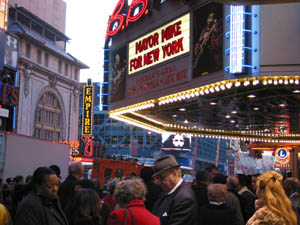
Mayor Michael R. Bloomberg launched his political campaign for reelection last night with a bash for volunteers at B.B. King’s in Times Square.

With the exception of Herman Badillo, most of the people who were approached in the hall were Democrats who liked the mayor but were not entirely ready to give their wholehearted endorsement ”“ perhaps hedging a bit or uncomfortable endorsing a Republican for mayor.

James E. Caldwell president of the 77th Precinct Community Council in Brooklyn was with his wife, Shirley Cardwell, an enthusiastic supporter of the mayor. But Mr. Cardwell, who said he was a Democrat, would not give a definitive endorsement to the mayor, even as he praised him. Mr. Cardwell said that instead, as a community leader, he wanted to make sure his neighbors were well informed about the mayor’s accomplishments.

When Ms. Cardwell was asked whether she supported the West Side Stadium for the Jets, she said, “Love it.” She added, “We’re all for the Nets.” Ms. Cardwell said the two projects were “good economically.” However, Ms. Cardwell indicated housing was at the top of her list.

Ms. Cardwell was referring to Bruce E. Ratner’s proposed development in Brooklyn that includes a basketball arena for the Nets. Many residents who live near where the proposed arena would be built have vigorously opposed it.

But many of the people interviewed also said the rising prosperity in the city was pricing seniors and low-income New Yorkers out of affordable housing in boroughs such as Brooklyn because people were moving in from more expensive places in Manhattan.

Patricia Scantlebury, who also lives in Brooklyn and was interviewed separately, said that housing was her number one issue. Ms. Scantlebury said the mayor needed to focus on making housing “affordable for people who can’t afford it.” When asked whether the mayor was making any progress, Ms. Scantlebury said the mayor was at least trying.

In a hall with a capacity of only 1,200, support for Mayor Bloomberg appeared to be overflowing. Most people held up signs and shouted “Four more years” and clapped and cheered the mayor.

But a sizable group stood behind the press riser, ignoring the mayor’s comments, while they talked amongst themselves, as they stood by an open bar the campaign had provided.

When Michael Bloomberg did speak he quickly indicated that he did not want people’s money, an unusual statement at a typical early political campaign event. Instead, Mr. Bloomberg said, he wanted the support of people in the room.

Mr. Bloomberg billed himself as a non-politician. He reminded his audience that he had been supported in the previous election because, “you knew that the difficult times ahead required a leader ”“ not a politician.” And he alluded to naysayers as people who were part of a “culture of failure.”

Mr. Bloomberg recited his administration’s accomplishments of low crime rates, education reform, and the revitalization of New York City in the aftermath of September 11.

He pledged to build a campaign army of 50,000 volunteers for his upcoming mayoral reelection campaign.

After Mr. Bloomberg spoke and left the stage, many began to leave even as a line of supporters was outside under the B.B. King marquee on 42nd street.

They stood as if waiting for a show to begin.

Posted in Government & Politics | Comments Off on Bloomberg Mayoral Campaign Opens on 42nd Street