A Streetlight Named Vittoria

By Maurice Pinzon
Vittoria Lui-Madonia, 21 and a senior at the School of Visual Arts, already has her own exhibition that introduces us to a photographer with maturity and great promise.

Lui-Madonia’s black and white photographs, taken at night in New York City and its nearby suburbs, reveals streets and buildings illuminated by a singular light, as if the street lamps turned on a certain way for Ms. Lui-Madonia to take the picture.

These may be streets, parks and houses we have walked by during the day. But not until Ms. Lui-Madonia ventures into the night to photograph them, do we focus our attention on these common places. Ms. Lui-Madonia’s photographs may elicit foreboding, solitude, even a strange stillness of the night. But most interestingly the photos seem like an excavation of the night, as if Ms. Lui-Madonia were the only person ever to have ventured onto the places she photographs.

Two striking pictures show us abandoned baby carriages in the night, one in Patterson, New Jersey and another by an arch at a bridge in Prospect Park, Brooklyn. There are other photos of streets and houses presented uniquely by way of Ms. Lui-Madonia’s eye.

This is how Ms. Lui-Madonia sees it: ìI work with the light at night because it is mysterious and beautiful. We have chosen to light up our world for practical reasons yet in doing so we have taken the most mundane places and turned them into perfect magical stages for the unknown. When I go out to photograph I like to drive around searching for those perfect little moments of mystery and drama.î

Last week at the opening of her exhibition in Williamsburg, Brooklyn Ms. Lui-Madonia explained how she found those places she photographed.

ìSometimes it’ll be something that I see. And I’ll remember it,î she said.

ìIt’s always by chance. It’s all about the moment and the light at night,î she explained.

Asked why there was only a single light in almost all her photographs, Ms. Lui-Madonia said, ìMy eye immediately goes to the glow. At night it glows and has a personality. It’s really is about the light and the feeling of the light.î

Ms. Lui-Madonia said sometimes she searches and goes back to a location at night because it has stuck in her mind when she passed it. Other times she imagines the place and searches for a place that resembles it.

About her photography she wrote: ìI want to show people that there is a whole other world out there when they are getting ready to go to bed. It is a world that is lonely and eerie yet beautiful and captivating at the same time.î

You can see that world at the Laila Lounge in Williamsburg, Brooklyn through December 6, 2004.
Posted in Arts, Photography | Comments Off on A Streetlight Named Vittoria

Mayor Bloomberg Practically in Campaign Mode

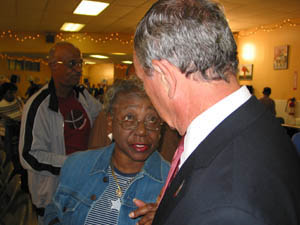
Mayor Bloomberg at Couche Senior Center. (Photo by Maurice Pinzon)

Mayor Bloomberg at Couche Senior Center. (Photo by Maurice Pinzon)

By Maurice Pinzon
Yesterday Mayor Michael R. Bloomberg was in Jamaica, Queens to announce that property tax rebate checks of $400 were in the mail. In a news conference, after receiving an overwhelmingly positive reception from a predominately African-American, Democratic audience, Mayor Bloomberg had a few words for any challenger in next year’s mayoral election. “As John Kerry said, Bring ’em on,” the mayor said.

Mayor Bloomberg visited the Robert Couche Senior Center purportedly to remind people that all homeowners would be receiving a tax rebate check of $400 from the City, but that they needed to make sure to register with the New York State School Tax Relief Program (STAR) if they had not done so, to get the municipal rebate.

For more about the City’s property tax rebate go to NYC Department of Finance

Mayor Bloomberg spoke before a packed lunchtime crowd with Council member James Sanders Jr. (D-Queens), who represents the community in the City Council and Eleanor Gibson Kelly, the director of the senior center, by the mayor’s side.

Then Mayor Bloomberg shook hands, chatted and had his picture taken with the seniors. Mayor Bloomberg shook hands with the people directly in front of him but also made an extra effort to reach those who remained seated.

With news photographers in tow, the mayor circled the dinning hall as people followed and surrounded him, while others eagerly waited for his attention.

Mayor Bloomberg then walked into the kitchen. The mayor said he wanted to sample the food to see if it was up to par for the seniors. One cook said to the mayor, “If it isn’t, it’s her fault”, laughing as he pointed to a fellow worker.

Then out of the kitchen, with more greetings and picture taking, until the mayor was finally able to reach the room where reporters were waiting for him.

But even with this demonstration of skillful campaign like movement through the dinning hall, one reporter still asked Mayor Bloomberg if voters might not see him as an aloof billionaire.

Mayor Bloomberg replied: “I think the answer to your question is go into that dinning room and ask people whether they think I’m out of touch. The reception that I just got in there it seems to me says the reverse.”

Indeed, James Jennuttu, sitting just outside the room where the news conference was held did have a good thing to say about the mayor. “I just liked him,” he said. Mr. Jennuttu said he had always voted for Democrats. Then he paused and asked this reporter the mayor’s party affiliation. He was told the mayor was a Republican. Asked if he would still vote for Mayor Bloomberg even though he was a Republican, Mr. Jennuttu said, “This time I might.”

Samuel Williams another member of the senior center said he was usually there for the lunchtime meal. Asked what he thought of the mayor, Mr. Williams said: “He’s doing a very good job.” Then Mr. Williams added, “I never thought I’d say that about a Republican.”

Asked if his fellow seniors might agree, Mr. Williams said, “I’m not sure anybody but Dinkins would have gotten this reception,” referring to former Mayor David N. Dinkins.

Mr. Williams indicated the mayor had a bad start to his tenure when he raised fees and taxes. But Mr. Williams attributed this to tough times. Then he added, “It’s worked out pretty well.”

Indeed Mayor Bloomberg had just admitted as much to reporters.

“I went to the city council and to the state legislature and asked them to raise taxes. It was the right thing to do at the time,” the mayor said. The mayor indicated that at that time, taxes had to be increased if New York City was not to fall into the disarray of the 70’s.

But now, Mayor Bloomberg explained, the City had just enough of a budgetary comfort level to give people a much needed real estate tax rebate.

“This is not a gift from the city, this is people getting back their own money,” Mayor Bloomberg said. The phrase similar to one President Bush uses. “It’s the people’s money, not the government’s, ” the president has said.

At the door to the senior center minutes after Mayor Bloomberg left, Council member Sanders was asked if he was surprised by the positive reception the mayor had just received.

“The mayor has done many smart things,” Council member Sanders said. The council member explained that people in the community were sophisticated, open and active. “This race is not a foregone conclusion,” Council member Sanders said about expectations that Democratic mayoral candidates could take the community’s vote for granted.

Posted in Government & Politics | Comments Off on Mayor Bloomberg Practically in Campaign Mode

When a Tabletop is Not Just a Tabletop

By Maurice Pinzon
Kimberlee Hewitt is a photojournalist and an artist. Although not well known in the galleries of Manhattan that may change soon.

The idea seems simple enough. Ms. Hewitt photographs restaurant tabletops while New Yorkers eat and drink with friends or alone. But with this seemingly simple concept Ms. Hewitt brings out in her photography the momentary arrangements and preoccupations of our lives. In Hewitt’s eyes, the tabletop is more than a tabletop – it is also a canvas.

In her first “Tabletop” photographs, Ms. Hewitt showed us the social interaction among friends amid the plates, napkins and the spilled wine on tables.

In her new photographs, Tabletops (Hope & Union Bakery 2004), Ms. Hewitt captures some of the more solitary moments of our New York lives, as we eat breakfast or lunch with a newspaper or book as our table companion. The photographs have a crisp artistic form conveyed in the juxtaposition of objects on the table.

But Ms. Hewitt noticed the full content of the pictures only when she began to review the photographs. “Different layers came out”¦I saw newspaper headlines emerging. All of a sudden my tabletops were dated political statements. This new theme that arose was, how people are ingesting the war, were learning about terrible acts of war, or news about the next election,” she said.

In one photograph there are three plastic containers with what appear to be coffee, chocolate and iced tea surrounding a smiling Bill Clinton on the cover of the New York Post. The Post headline reads, “It’s My Party”. It is perhaps a headline from this year’s Democratic National Convention. In the picture the former president is laughing, behind him is a stripe of vivid green. The tablecloth on the table in the picture somehow matches the green stripe behind Clinton on the Post cover.

Helen Jackson is a college student who frequently eats at the Hope and Union Bakery in Williamsburg where the photographs were taken and are being exhibited. Ms. Jackson said she usually plays scrabble or reads the paper while having coffee or a bite to eat. She liked the Clinton New York Post picture. “Yes, it’s so good,” she said as if evaluating the food at the cafe.

Posted in Photography | Comments Off on When a Tabletop is Not Just a Tabletop