Comptroller Thompson Raises Questions About West Side Development Plan

By Maurice Pinzon
Today New York City Comptroller William C. Thompson, Jr. questioned whether the construction of a New York Jets stadium and commercial development on the West Side of Manhattan would provide as much revenue for the City as some expect.

In an exclusive interview with New York News Network in his office, he said, “I don’t know that the stadium returns a lot of additional revenue. I don’t care how anybody tries to dress it up,” he said. “I mean, as an adjunct to Javits [Center] and a bunch of other things ”” it’s a stadium. It’s a 75,000-seat stadium.”

In contrast, the comptroller fully supported expansion of the Jacob Javits Convention Center because he said numbers could show that it would bring revenue and jobs to the city. Regardless of whether the stadium is built, Comptroller Thompson said construction of the convention center should not be delayed.

He also agreed that extending the No. 7 subway line to the West Side would be important to any future development in the area. However, the comptroller recommended that the City postpone the No. 7 line expansion to see if the project could be included in the MTA’s capital budget. Under the current proposal the City has indicated that it will pay for the expansion.

In addition, Comptroller Thompson questioned the need for additional commercial space in midtown Manhattan, which he said has a vacancy rate of 11 percent to 12 percent, at a time when various commercial projects are being planned. These projects include the World Trade Center site in lower Manhattan, the Atlantic Yards Project and the expansion of MetroTech in Brooklyn, and the waterfront development in Long Island City.

The City and the State are expected to announce an agreement on the West Side stadium and convention center development tomorrow.

Posted in Government & Politics | Comments Off on Comptroller Thompson Raises Questions About West Side Development Plan

Carol Robles-Roman: A Quiet Elegant Efficiency in City Hall

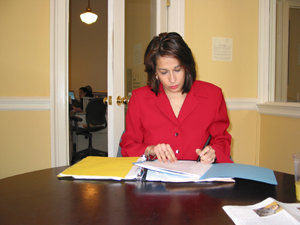
Deputy Mayor Carol Robles-Roman (Photo by Maurice Pinzon)

Deputy Mayor Carol Robles-Roman (Photo by Maurice Pinzon)

By Maurice Pinzon
Yesterday, Mayor Michael R. Bloomberg held a ceremony in the Governor’s Room at City Hall to grant citizenship to the family of U.S. Army Pfc. Luis Moreno, who died in Iraq. Before the ceremony, Deputy Mayor Carol Robles-Roman could be seen greeting the Moreno family and military personnel in a back room. Then, reporters, cameras and lights encircled the Moreno family to capture their grief. A member of the mayor’s security detail reminded the photographers that it was a solemn occasion.


At that moment, in a red business dress, Deputy Mayor Robles-Roman was far removed from the spotlight, standing almost in the adjoining room. Deputy Mayor Robles-Roman does not have the political street-tough appearance of a Ninfa Segarra, who served as a deputy mayor under Rudolph Giuliani. Instead, Deputy Mayor Robles Roman displayed an aura that permeates the best officials in the Bloomberg administration — a certain technocratic elegance.

In an interview with News York News Network after yesterday’s ceremony, Deputy Mayor Robles-Roman perked up as she spoke about the paths she took in life to reach her current position. Deputy Mayor Robles-Roman was born in New York City. She has lived in all of the city’s boroughs, except Staten Island. She marched in the Puerto Rican Day Parade when she was eight years old, then marched again in 2003 alongside Mayor Bloomberg. “I felt like I died and went to heaven,” she said yesterday with great pride.

Indeed, she said that one of her most fulfilling responsibilities is going out to speak to young students. Deputy Mayor Robles-Roman said she encourages the students to focus on their future and to think of becoming not deputy mayor but mayor or governor. She said she often gets emails from students after her appearances.

A graduate of New York University Law School, Deputy Mayor Robles-Roman first worked as a corporate lawyer but soon felt compelled to work in family court, a place where she could do the things she wanted to accomplish, she said. Although she enjoyed the perks of being a corporate lawyer, she wanted to demonstrate her law school idealism in a more immediate and concrete way.

Deputy Mayor Robles-Roman was not an expert in family law, but she found a way to get a job with the court anyway. “I talked myself into the job,” she said. The deputy mayor eventually became the highest-ranked non-judicial official in the court. Explaining her shift from corporate law to the public sector, Deputy Mayor Robles-Roman said, “I liked the activism. I liked the immediate impact.” In her current position, Deputy Mayor Robles-Roman likes the feeling of being able to enter “a room, see a problem and be able to fix it.”

The deputy mayor seems genuinely thrilled to work for Mayor Bloomberg, a person who, according to her view, has both a disciplined mind and an instinct for fairness. “Working with Michael Bloomberg is just a very dynamic experience. He really lets you do your job. He’s not a micromanager, but he’s an incredible leader. He brings enthusiasm and energy and focus — just an incredible ability to focus.”

Deputy Mayor Robles-Roman was intimately involved in the negotiations with advocates and the City Council that resulted in Executive Order 41, which expanded privacy protections for all New Yorkers. Executive Order 41 was an issue particularly important to the immigrant community in New York City. Although Council member Hiram Monserrate is credited with bringing the issue to the forefront, Deputy Mayor Robles-Roman said yesterday it was an issue the Bloomberg Administration had been considering for some time before it received so much attention. The deputy mayor said that when she bumps into Council member Monserrate, they often reflect on the accomplishment.

In vetting the mayor’s judicial appointments — the mayor appoints family and criminal court judges — the deputy mayor said she admired his “ability to read individuals.” She recounted Mayor Bloomberg once saying, “I never want to send a woman and her three kids in front of that person,” referring to a judicial nominee whom he felt did not have the necessary judicial temperament.

Indeed the appointment of judges is a branch of government that Deputy Mayor Robles-Roman said truly has “quality of life” implications for families going through the court system. The decisions of these judges can dramatically change people’s lives.

Praising the mayor highly, Deputy Mayor Robles-Roman said she felt she had the full support of Mayor Bloomberg and his staff. Perhaps the scenario is to be expected from someone working for a mayor. But her words were notable, nonetheless. “Michael Bloomberg is an incredibly loyal man and an incredibly good boss, and most important, he is an incredible mayor who cares,” she said.

Deputy Mayor Robles-Roman is Mayor Michael R. Bloomberg’s Counsel and is Deputy Mayor for Legal Affairs, a position the mayor created. She advises the mayor on City Hall legal issues but also oversees the Offices of Criminal Justice Coordinator, Administrative Trials and Hearings, Immigrant Affairs, Combat Domestic Violence, People with Disabilities, Veteran’s Affairs, and the Commissions: On Human Rights and Women’s Issues. In addition, Deputy Mayor Robles-Roman liaisons with the Mayor’s Committee on the Judiciary, Administrative Trial Judges, the Civilian Complaint Review Board, Conflict of Interest Board, and the Commissions to Combat Police Corruption, Equal Employment Practices, Voters Assistance.


Posted in Government & Politics | Comments Off on Carol Robles-Roman: A Quiet Elegant Efficiency in City Hall

Let 100 Business Districts Bloom

By Maurice Pinzon
Today the New York City Planning Commission approved a new Business Improvement District (BID) for the Manhattan’s Flatiron district. With strong support from local business owners, landlords and elected officials, and no major opposition expected, the BID is likely to begin operations soon. The City Council just needs to pass legislation approving the district, and the mayor must sign it.

Sharon Ullman, the president of the 23rd Street Association, said she had been interested in establishing a BID since 1989 but waited until Mayor Bloomberg took office because his administration was “pro-BID.” She also knew that the Commissioner of Small Business Services, Robert W. Walsh, would be fully supportive. “It made a huge difference,” she said.

Over the last year-and-a-half, Ms. Ullman said she had been “knocking on doors,” often “every day of the week, eight hours a day,” talking to merchants at retail stores about how a BID would benefit their businesses.

The proposed BID would roughly include the area bordered by 21st Street to the south and 29th Street to the north, Sixth Avenue to the west, extending eastward to Park Avenue South, in places almost reaching Third Avenue Ms. Ullman said the top priorities for the district were “sanitation, security and marketing.” The proposed budget for the district is $1.7 million.

BID’s allow property owners in commercial districts to set up nonprofit entities that provide enhanced services to the area. These services usually include sanitation and security to supplement existing City services. BID’s also provide additional services, such as marketing. The BID gets operating funds for these services through an additional fee assessment on properties within the BID.

The expansion of BID’s throughout the City — there are about 20 at different stages of development — to a great extent is due to Commissioner Walsh, who, at Mayor Bloomberg’s urging, has tried to “re-energize” commercial districts by making it easier for them to set up BID’s. It seems that Commissioner Walsh does not need much prompting. At times he seems like the Jane Jacobs of New York City’s commercial neighborhoods.

Yesterday, Commissioner Walsh and Ms. Ullman took reporters on a short walking tour of part of the proposed district. Commissioner Walsh, who operated the 14th Street BID years before becoming a commissioner, said a Flatiron/Madison BID would be “fine tuning” an already very good commercial district. Even a thriving commercial area needs a BID, Ms. Ullman pointed out. With “a lot of traffic on the streets,” she said, you have “more population, and the streets get pretty dirty.”

Walking along 23rd Street, the commissioner appeared to relish pointing to the little things that a BID could fix — a tree that needed pruning, graffiti that should be removed from building walls, sidewalks that could use repairs — all downgrading an otherwise fine commercial streetscape. With his enthusiasm for detail, he pointed to canopies on the south side of 23rd Street, between Park Avenue South and Broadway. The canopies jetted out, obstructing one another, making the block look unappealing for all. Then Commissioner Walsh pointed to a brand new store that had no canopy and said, “Look how much better that looks.”

But Commissioner Walsh was not done. He pointed to an apparently vacant commercial building and said that a BID could get in touch with the landlord, whom he speculated might be in Florida and may have forgotten about the property. According to the commissioner, the BID could offer the owner help in marketing the space.

“You can argue that BID’s have a knack for coordinating these issues,” Commissioner Walsh said yesterday.

Posted in Economy, Government & Politics | Comments Off on Let 100 Business Districts Bloom